
Summary:
Recent cross-border attacks involving drones and missiles between India and Pakistan signal a troubling evolution in their longstanding conflict. As both nuclear-armed neighbors deploy advanced unmanned systems, global observers warn of an escalation risk in South Asia.
A Technological Shift in a Decades-Old Rivalry
The longstanding and volatile conflict between India and Pakistan has taken a modern turn with the onset of drone warfare. On Thursday, India accused Pakistan of orchestrating drone and missile attacks targeting military sites in both mainland India and the Indian-administered region of Kashmir. Pakistan denied the accusations, instead alleging it had downed 25 Indian drones in recent hours across major cities, including Karachi and Lahore. India has not officially responded.
This exchange, involving unmanned systems rather than traditional manned aircraft, represents a significant shift. Experts warn that the increasing use of drones could alter the balance of military engagement by enabling more discreet, targeted strikes that are harder to attribute — yet still provocative enough to risk escalation.
Civilian Casualties Mount as Conflict Intensifies
The clashes have already resulted in a tragic loss of life. Pakistani officials claim Indian strikes have killed 36 civilians and injured dozens more in Pakistan and Pakistan-administered Kashmir. On the Indian side, at least 16 deaths have been reported due to shelling allegedly from Pakistan. India maintains that its operations were in response to a militant attack on tourists in Pahalgam, which Islamabad denies involvement in.
As missile debris litters villages near the border, both sides continue to issue contradicting reports of intercepted drones, neutralized systems, and retaliatory action, with global powers urging calm to prevent further deterioration.
Drone Technology Takes Center Stage
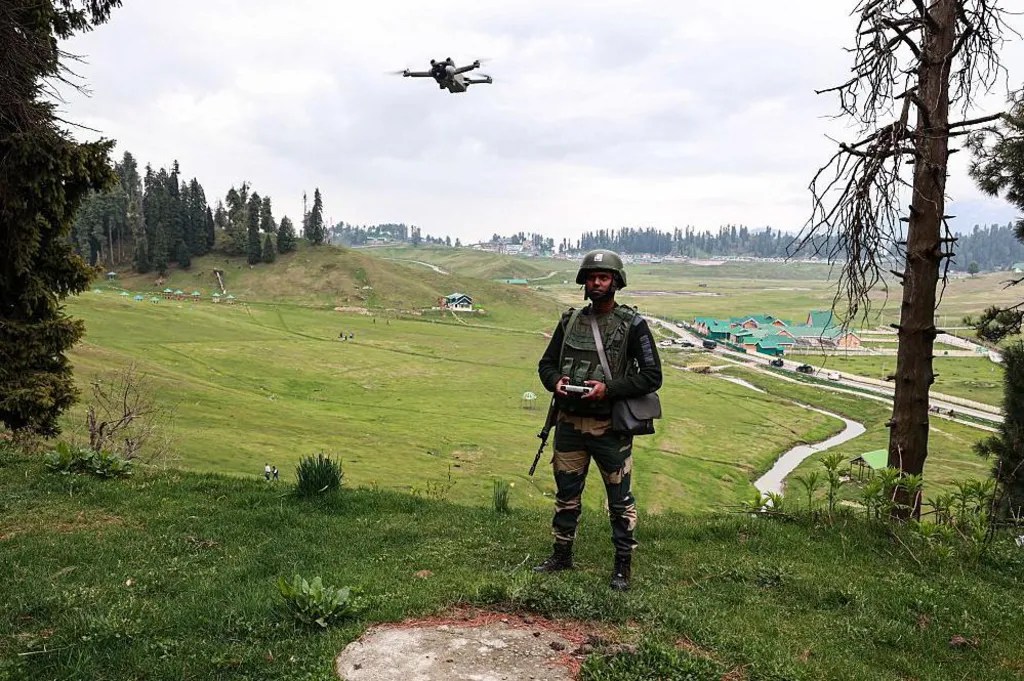
The growing reliance on unmanned aerial vehicles (UAVs) reflects broader military trends seen globally. Drones can play a dual role: surveilling enemy positions and serving as direct strike platforms. Their capability to loiter, designate targets, and evade radar systems makes them a strategic asset.
India’s drone arsenal includes Israeli-made platforms like the Heron and Harop — the latter capable of both reconnaissance and autonomous strikes. The country also recently secured a $4 billion deal with the U.S. for 31 MQ-9B Predator drones, significantly enhancing its high-altitude strike capabilities. These can fly up to 40 hours and reach altitudes of 40,000 feet.
Meanwhile, India is also experimenting with swarm drone tactics, which involve deploying numerous small UAVs to overwhelm enemy air defences.
Pakistan’s Expanding Drone Capabilities
Pakistan’s drone fleet is reportedly extensive, combining imported models with homegrown technologies. According to defence analysts, the country operates over a thousand UAVs, including China’s CH-4, Turkey’s Bayraktar Akinci, and its own Burraq and Shahpar drones. The military has also been integrating loitering munitions and developing “loyal wingman” drones to work alongside piloted aircraft.
This ongoing build-up underscores the growing arms race between the two nations, with each relying on different global partners for technological support. While India leans heavily on Israeli and U.S. suppliers, Pakistan collaborates with China and Turkey.
Lessons from Ukraine, Risks in South Asia
Though the current use of drones in South Asia resembles modern tactics observed in Ukraine’s ongoing war, analysts note key differences. The scale and intensity of drone usage in the India-Pakistan context remain comparatively lower. Nevertheless, the deployment of UAVs in such a sensitive and nuclear-charged region is raising global concerns.
Experts highlight that using drones may appear to lower the threshold for military engagement, offering a seemingly less provocative option compared to manned jet strikes. However, the political and symbolic weight of each drone strike — and each intercepted radar — could still lead to escalation.
The Road Ahead: Escalation or Restraint?
While some analysts see the current drone activity as a tactical tit-for-tat, others fear it could be a precursor to broader military operations. Whether this marks the beginning of a larger conflict or a new form of limited engagement is unclear.
India’s integration of drones into its strategic framework aims to deliver precision strikes without escalating into full-scale air conflict. However, the increasing reliance on unmanned systems introduces new risks — each engagement could become a trigger in a region already marked by decades of mistrust and volatility.
As international leaders call for de-escalation, the future of South Asia’s stability may depend on how India and Pakistan navigate this new era of warfare.




 gyanugenai
Leave a comment