
Summary:
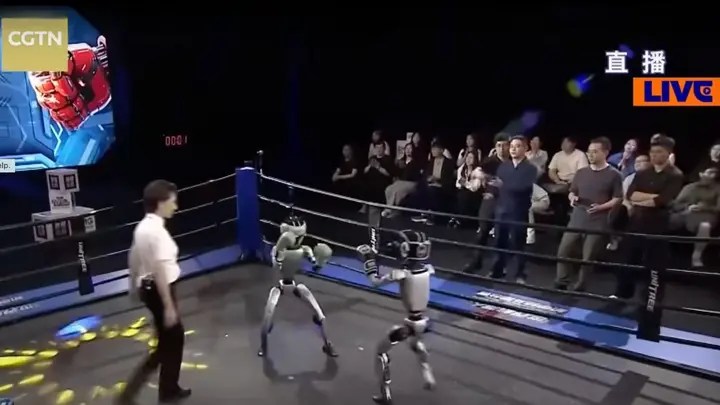
In a groundbreaking event held in Hangzhou, China, Unitree Robotics hosted its first robot boxing tournament featuring four humanoid G1 robots. Operated by humans, the match demonstrated how far robotic motion and real-time reaction capabilities have advanced.
A New Era of Robot Combat Unfolds in China
Hangzhou, China, became the stage for an unusual and futuristic sporting event — a boxing match between humanoid robots. The “Unitree Iron Fist King: Awakening!” tournament showcased four G1 robots in a controlled martial arts-style competition, drawing tech enthusiasts and casual onlookers alike.
Hosted near Unitree Robotics’ new manufacturing facility, the event was designed to demonstrate the agility and combat readiness of its G1 robots. These machines, guided by human operators, impressed spectators with fluid movements and tactical responsiveness.
Tournament Format: Rules and Scoring
The matches followed a three-round format, with each round lasting two minutes. The scoring system was straightforward: hand strikes earned one point, while leg strikes scored three. Knockdowns resulted in penalties if the robot failed to recover within eight seconds. The rules ensured fast-paced action, mirroring traditional martial arts competition while putting robotic reflexes to the test.
Match Highlights: Knockouts and Strategy
The opening round saw “AI Strategist,” operated by Lu Xin, dominate “Silk Artisan,” controlled by Jiao Tianqi. With precise strikes, AI Strategist secured a knockout victory in the final round.
In the second match, “Energy Guardian” faced off against “Armored Mulan.” After delivering a powerful knockdown early in the bout, Energy Guardian maintained its lead and emerged victorious despite a late stumble.
The final match brought AI Strategist back into the ring to face Energy Guardian. AI Strategist displayed superior tactical adaptability, scoring three back-to-back knockouts and claiming the tournament title. Robotics expert Zhou Di remarked on the event’s significance, noting the robots’ real-time ability to adjust to opponents as a major technological breakthrough.
What Sets the Unitree G1 Robot Apart?
Standing at 4.3 feet and weighing around 77 pounds, the Unitree G1 robot is a lightweight yet powerful machine. With 23 degrees of freedom and robust joint construction, it can execute complex movements like side kicks and kip-ups. Although slightly bulky, its motion is surprisingly smooth thanks to its advanced hardware and software integration.
The G1 is designed to be more affordable and portable than Unitree’s higher-end H1 model, which stands nearly six feet tall and costs over $90,000. In contrast, the G1 is foldable, transportable by a single person, and can reach speeds of 4.5 mph. Much of its dynamic motion comes from the LAFAN1 dataset, which translates human movements into executable robotic actions.
Real-World Performance: Live Combat as a Test Bed
More than just an exhibition, the tournament served as a real-world stress test for the G1’s systems — including sensors, motors, and algorithms. The matches revealed minor imperfections, such as brief response lags and balance issues after strong impacts. Still, the overall performance confirmed the G1’s robustness under pressure.
Evolving Robots: Control Methods and Learning Capabilities
One of the standout features of the Unitree G1 is its adaptability. The robots can be operated using motion sensors, traditional gaming-style controllers, or even voice commands. As these machines continue to learn from repeated use, their performance is expected to improve. Unitree plans to make these events accessible through both live broadcasts and on-site attendance, aiming to bring robot sports to a wider audience.
Source: Fox News




 gyanugenai
Leave a comment