
Summary:
Kepler Robotics has introduced its K2 “Bumblebee” humanoid robot at the SAIC-GM automotive plant in Shanghai. Designed for demanding industrial tasks, the K2 is now being tested in real-world conditions, signaling a transformative step in the use of intelligent machines in manufacturing.
K2 “Bumblebee” Begins Factory Trials in Shanghai
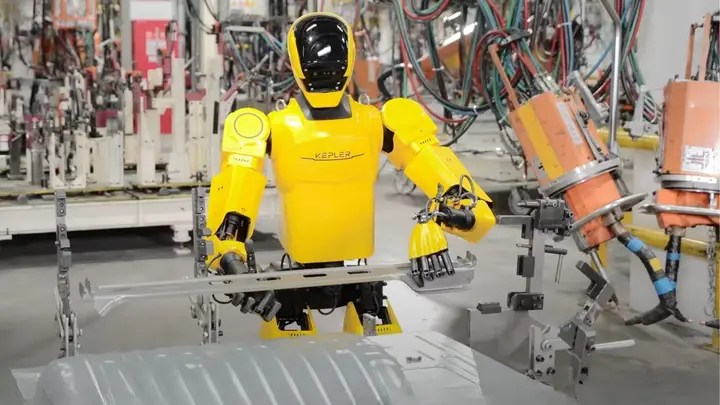
Kepler Robotics has officially launched its Forerunner K2 humanoid robot—nicknamed “Bumblebee”—at the SAIC-GM automotive facility in Shanghai. This marks one of the first large-scale, real-world deployments of humanoid robots in a high-volume manufacturing setting. In a recent demonstration video, the K2 is shown autonomously navigating factory floors, performing quality checks, and handling assembly-line tasks with notable precision.
The deployment represents the start of scenario-based evaluations, where the K2’s performance will be assessed in active production environments. These tests will provide insight into how humanoid robots can complement existing manufacturing workflows and improve operational efficiency.
How the K2 Is Changing the Factory Floor
Engineered to meet the demands of modern industry, the K2 “Bumblebee” showcases a wide range of capabilities. At SAIC-GM, the robot has already been used to load stamped automotive parts, operate mechanical fixtures, and inspect components. Thanks to a blend of imitation learning and reinforcement learning, the K2 can adapt to new tasks on the go.
With its advanced mobility and sensor array, the robot can navigate through tight factory spaces and work safely alongside human staff. Its integration into the SAIC-GM facility reflects a growing trend toward hybrid production models, where humans and machines collaborate to boost quality, safety, and productivity.
Major Improvements Over Previous Models
The K2 is a significant upgrade from its predecessor, the K1. It features a more durable structure, redesigned limbs for easier maintenance, and dexterous hands with 11 degrees of freedom. Each fingertip is equipped with sensors that enhance grip and movement precision.
Its internal power system allows up to eight hours of uninterrupted operation—essential for industrial applications. On the software side, the K2 uses a cloud-based cognitive system, enabling it to learn new skills rapidly and coordinate full-body movement. Enhanced AI algorithms support better decision-making, object recognition, and coordination with human coworkers.
Expanding Beyond Automotive: K2’s Future Roles
Kepler Robotics has ambitions that extend beyond the factory floor. The K2 has been designed with versatility in mind, and the company envisions it playing roles in sectors such as education, logistics, public safety, and research.
In classrooms, the robot could assist with interactive learning and tutoring. In logistics, it can automate warehouse operations and improve inventory accuracy. Its sensor suite enables it to operate in security settings, such as patrolling buildings and detecting hazards. Moreover, the K2’s rugged design allows it to function in extreme environments, including those with exposure to radiation or explosive materials.
Features That Make the K2 Stand Out
What makes the K2 unique is its balance of power and precision. With fine-tuned manipulators and real-time learning capabilities, it can handle both delicate and labor-intensive tasks. Its extended battery life and autonomous movement make it suitable for long shifts without constant human oversight.
Affordability is another key factor. Priced around $30,000, the K2 is considered a cost-effective solution for manufacturers aiming to enhance productivity. In many cases, a single K2 can match or surpass the output of several human workers, making it an attractive investment for industries under pressure to optimize performance.
Addressing the Job Displacement Debate
The integration of humanoid robots naturally raises concerns about their impact on employment. While it’s true that automation can replace certain repetitive tasks, industry experts suggest that the broader outcome may be more complex. Instead of eliminating jobs, robots like the K2 could help shift labor toward higher-value roles.
As factories adopt advanced robotics, new opportunities are expected to arise in areas such as robot maintenance, software development, and AI training. These positions require different skill sets and offer more specialized career paths. Many industry analysts view humanoid robots as collaborators rather than replacements—relieving humans from monotonous or hazardous duties while enabling them to focus on creative and supervisory work.
This collaborative approach, often referred to as “cobot” integration, is expected to redefine how human and robotic labor coexists, leading to safer, more innovative work environments.
Source: Fox News




 gyanugenai
Leave a comment